← TRAINING

// TRAINING QUIZ

Are you ready for training and to scale up in AI?

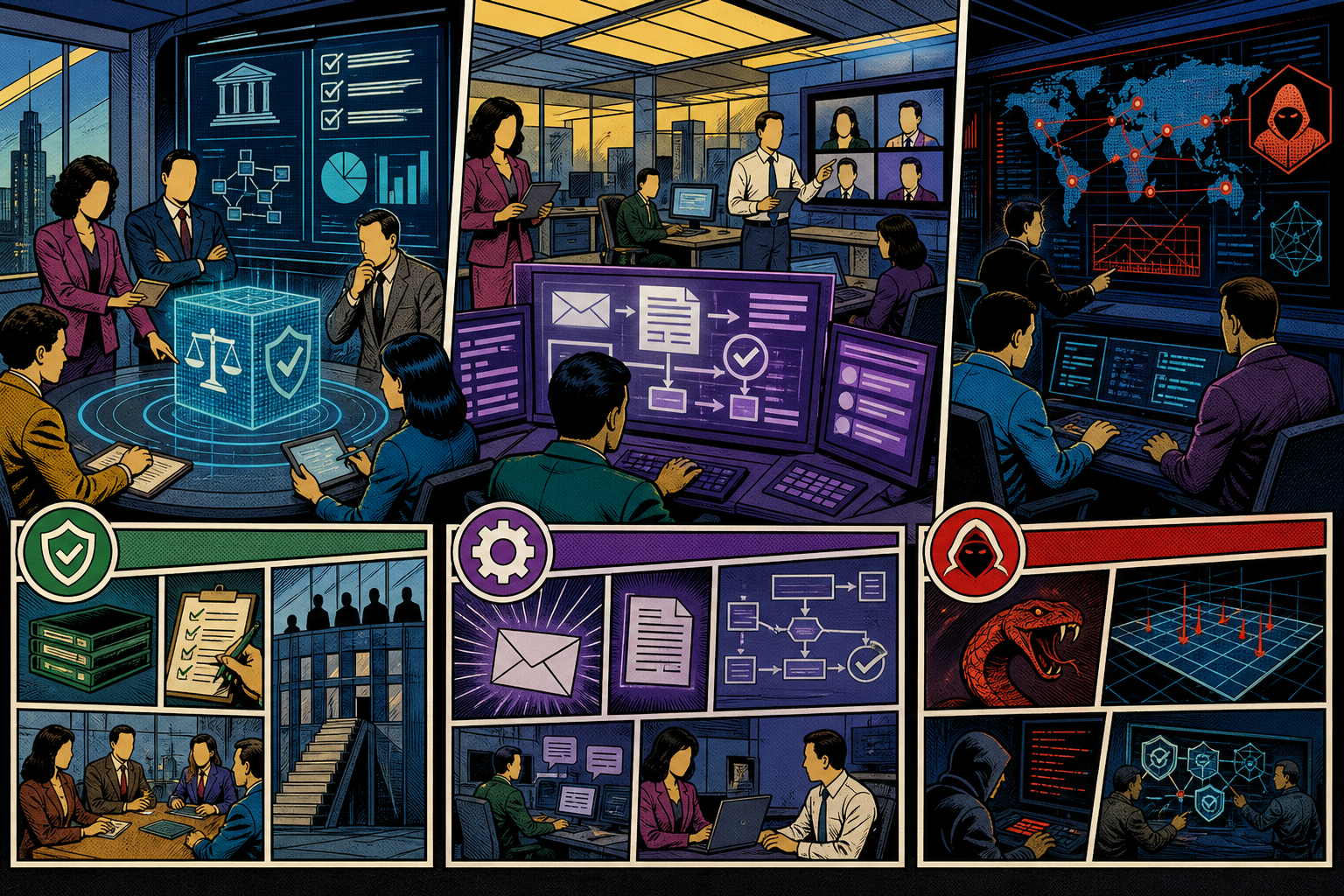
A practical 12-question diagnostic self-assessment for corporate learners preparing for Quantropic.ai courses in AI Governance, AI Workflow Deployment, Red Teaming with Viper and AI, and integrated corporate AI readiness. Score 1 point per question. Use topic-level results to identify the best starting pathway: governance, workflow deployment, red teaming, or a combined implementation route.
12 QUESTIONS DIFFICULTY 2/5 MULTI-ANSWER
01 AI Governance Starter Kit

Your COO wants to announce a company-wide AI Governance Starter Kit in 30 days. Several teams already use generative AI informally, but there is no inventory, no named risk owners, and no standard approval route. Which starter-kit package is most review-ready for executives and audit?

This tests whether the learner can distinguish an audit-ready governance starter kit from informal AI guidance. The correct answer combines ownership, risk classification, acceptable use, approvals, evidence, exceptions, and executive reporting, which are necessary for review and rollout. Wrong answers indicate a gap in understanding that governance is an operating system for decisions and accountability, not just awareness material, procurement review, or technical testing.

02 AI Governance Starter Kit

A sales manager wants approval to use an external AI tool to summarise customer call notes. The notes may include client names, contract issues, pricing concerns, and unresolved complaints. What should the governance lead do first?

This tests practical governance triage for a real business use case. The correct answer balances productivity with data classification, ownership, privacy, acceptable use, and approval controls. Wrong answers reveal either over-permissive adoption, weak privacy controls, or overly broad blocking that prevents responsible AI adoption.

03 AI Governance Starter Kit

Your executive sponsor asks for a monthly AI governance report that will help them decide whether AI adoption is controlled enough to expand. Which items should be included? Select all that apply.

This tests executive reporting competence. The correct items provide decision-ready visibility into adoption, ownership, risk, exceptions, incidents, and remediation. The wrong answer suggests a communications-focused approach that may impress stakeholders but does not support oversight, audit readiness, or responsible expansion.

04 AI Workflow Deployment

A department wants its first internal AI Copilot workflow inside Outlook and Teams. Candidate workflows include confidential contract negotiation, routine meeting-summary drafting, automated performance reviews, and finance approval routing. Which first pilot is most appropriate for a safe deployment?

This tests workflow selection for a first AI deployment. The correct answer chooses a high-volume, lower-risk workflow with human review and bounded data. Wrong answers indicate a tendency to start with sensitive, high-impact, or fully automated workflows before controls, user trust, and operational monitoring are mature.

05 AI Workflow Deployment

A team is configuring an Outlook and Teams Copilot extension to draft client emails from internal notes. Which control is most important before broad deployment?

This tests safe operational deployment of AI-assisted communication. The correct answer keeps accountability with the employee and reduces risks involving accuracy, tone, disclosure, and misdirected communication. Wrong answers show gaps in human review, data handling, deployment controls, and adoption planning.

06 AI Workflow Deployment

After an internal AI Copilot goes live, employees report that summaries are useful but sometimes omit important approval conditions. Managers are still copying summaries into decision records without checking them. What is the best next step?

This tests post-deployment governance of workflow quality and human accountability. The correct answer improves the workflow, reinforces user responsibility, and uses monitoring before scale-up. Wrong answers indicate either unnecessary abandonment, over-reliance on users without design fixes, or misplaced trust in seniority instead of controls.

07 Red Teaming with Viper and AI

Your security lead proposes using Viper and AI to assess risks in a newly approved internal AI workflow. Which planning elements are required for a safe, corporate red-team exercise? Select all that apply.

This tests safe red-team planning readiness. The correct answers establish permission, scope, ownership, defensive intent, reporting, and remediation. The wrong answer indicates a serious governance gap: unsanctioned expansion of testing can create legal, operational, and trust risks.

08 Red Teaming with Viper and AI

A red-team exercise identifies that employees may paste restricted internal documents into an AI workflow that was approved only for general business content. What is the best way to classify and report the finding?

This tests vulnerability awareness and risk reporting without unsafe detail. The correct answer frames the issue as a control and governance gap tied to business impact and remediation. Wrong answers reveal gaps such as blaming users only, mishandling sensitive evidence, or underestimating near-miss risks.

09 Red Teaming with Viper and AI

A senior manager asks the red-team group to include a vendor platform in next week's Viper and AI assessment because the vendor is connected to an internal workflow. The contract does not mention red-team testing. What should the team do?

This tests permission boundaries and third-party risk judgment. The correct answer protects the organization by respecting scope, contracts, and approval channels while still escalating the risk. Wrong answers show risky assumptions about connected systems, informal authorization, or incomplete reporting.

10 Integrated Corporate AI Readiness

A learner scores strongly on workflow deployment but poorly on governance. Their business unit wants to deploy an Outlook and Teams Copilot for approval routing within six weeks. What is the best Quantropic.ai starting pathway?

This tests pathway selection based on diagnostic gaps. The correct answer follows the rule that if governance is the lowest score, governance should come first, especially before approval routing. Wrong answers indicate over-weighting existing strengths, sequencing red teaming before basic governance, or letting urgency override readiness.

11 Integrated Corporate AI Readiness

Your company is preparing a combined AI rollout: an acceptable-use policy, an internal Copilot pilot, and a defensive red-team assessment. Which sequencing is most operationally sound?

This tests integrated rollout sequencing. The correct answer connects governance, controlled deployment, defensive testing, and remediation before scale. Wrong answers reveal gaps such as reactive governance, overbroad testing, or assuming policy alone controls operational risk.

12 Integrated Corporate AI Readiness

A department has balanced but low scores across governance, workflow deployment, and red-team readiness. Leaders are enthusiastic but lack a use-case inventory, approved controls, pilot criteria, or remediation process. What recommendation best fits the diagnostic result?

This tests interpretation of balanced low readiness. The correct answer follows the diagnostic matrix: if all scores are balanced but low, start with AI Governance Starter Kit to create the operating foundation. Wrong answers indicate confusing enthusiasm or consistency with readiness, and sequencing advanced activities before basic controls.