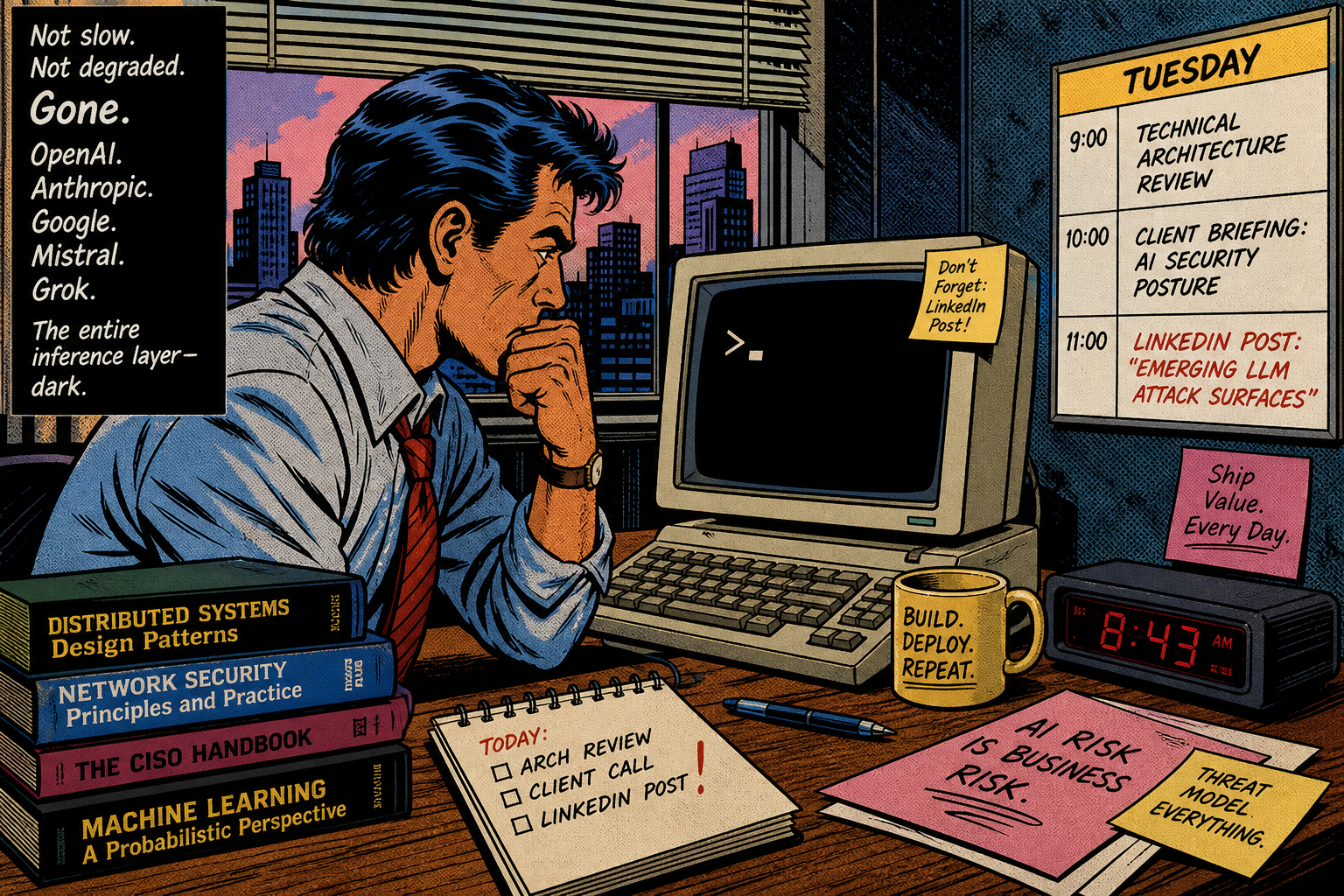
The Morning the Models Are Gone
You wake up. The APIs are down. Every last one.
Not slow. Not degraded. Gone. OpenAI. Anthropic. Google. Mistral. Grok. The entire inference layer — dark.
Your calendar shows three meetings before noon. A technical architecture review. A client briefing on AI security posture. A LinkedIn post you promised to publish this morning on “emerging LLM attack surfaces.” You open your laptop. You stare at the blank prompt window. The cursor blinks.
And then it hits you — not like a thought, but like a physical sensation in the chest: You don’t actually know how to do any of this.
Let’s slow that moment down, because it deserves more than a passing discomfort.
Over the last two to three years, a very large number of professionals across every technical and creative discipline have quietly outsourced their cognitive load to AI inference engines. Not maliciously. Not lazily, even. It happened gradually, the way all dependency does — first as a useful shortcut, then as a workflow, then as infrastructure, and finally as identity. The consultant who used to spend three hours structuring a strategic memo now spends twenty minutes reviewing one. The developer who understood every line of code now ships functions they can explain but could not write from scratch under time pressure. The security analyst who built threat models from first principles now prompts their way to a risk matrix and adjusts the language.
None of this is wrong, exactly. Leverage is the point of tools. Nobody handwrites machine code anymore.
But there is a difference — a specific, important difference — between a tool that extends a skill you actually have and one that replaces a skill you never built. A power drill extends a carpenter’s hand. It does not teach anyone carpentry. And right now, a significant portion of the workforce is carrying a power drill they believe has made them a carpenter.
The Borrowed Skill Problem
Call it what it is: borrowed competence. You have access to the output of genuine expertise — the structured argument, the code that works, the threat model, the polished prose — without having developed the underlying capability yourself. The model generates it. You review it, shape it, publish it. The output is real. The skill transfer is not.
This would be a minor philosophical footnote except for one thing: borrowed competence is fragile in ways that built competence is not.
Built competence degrades slowly, predictably, and can be recovered. You haven’t written raw SQL in a year? You’ll be rusty for an afternoon. You haven’t structured a board-level risk narrative without AI assistance in eighteen months? That is a different kind of problem. The templates are gone. The muscle memory is gone. The instinctive sense of what matters and what is noise — the thing that took years to develop — has atrophied, quietly, while the model was doing it for you.
The deeper issue is that most people cannot tell the difference. The experience of prompting your way to a good document feels like thinking. It involves judgment, iteration, curation. You are not passive. But the cognitive substrate — the part of your brain that would have produced that structure independently, from scratch, under pressure — was not exercised. It was bypassed.
What Actually Gets Borrowed
Let’s be specific, because the categories matter:
Technical depth. The developer who learns to code by reading AI-generated explanations and debugging AI-generated code is building pattern recognition, not understanding. They can iterate on solutions. They cannot design them from first principles. The gap is invisible until it isn’t — until the interviewer asks them to write a binary search on a whiteboard, or until the production incident happens at 2am and the model is unavailable or confidently wrong.
Analytical judgment. The analyst who uses AI to synthesise research, identify patterns, and structure findings is still doing analysis. But the part of analysis that actually builds judgment — sitting with ambiguous data, being wrong, building mental models of why systems behave the way they do — that part is largely absent. The AI is faster and more confident. It does not transmit the scar tissue of being confident and wrong.
Domain fluency. This one is subtle. There is a difference between knowing what questions to ask in a domain and knowing the domain. AI makes it very easy to ask good questions in domains you do not understand. It generates the vocabulary, the frameworks, the contextual structure. It can make a generalist sound like a specialist for the length of a meeting. It cannot make them a specialist. The difference becomes visible the moment the conversation goes off-script — when someone asks a follow-up question that requires genuine mental models, not pattern-matched language.
Creative instinct. Writers who prompt their way to first drafts and then edit them are learning something real. But they are not learning to stare at a blank page and generate structure from nothing. That specific capability — which is, in a meaningful sense, what writing is — is increasingly untested. The blank page is no longer blank. The most dangerous thing AI does to creative work is not that it produces bad output. It is that it removes the experience of productive struggle, which is where most of creative judgment actually develops.
The Regulatory Variable
Now add a policy dimension, because it is no longer hypothetical.
The United States government — and increasingly other jurisdictions — is actively debating AI access restrictions. Export controls on frontier models. Sector-specific prohibitions. Compute thresholds. Mandatory human oversight requirements that effectively prohibit certain classes of AI use in high-stakes domains. The EU AI Act is already in effect in parts. China’s AI regulations impose content and capability restrictions. India is watching. Singapore has its frameworks.
This is not a matter of if. It is a matter of when and how much.
If you work in finance, healthcare, critical infrastructure, legal services, or defence-adjacent sectors, the probability that AI-assisted workflows will face regulatory friction within the next five years is not small. It is high. And when that friction arrives — when the model you rely on is classified as a prohibited high-capability system in your jurisdiction, or when your industry regulator decides that AI-generated risk assessments do not satisfy professional accountability requirements — the question becomes very simple: What can you actually do without it?
The answer, for many professionals, is going to be uncomfortable.
The Atrophy Timeline
Here is what makes this particularly insidious: cognitive atrophy from disuse does not announce itself.
You do not feel stupider. You feel more efficient. The output of your AI-assisted work is often genuinely better than what you would have produced alone, especially in the early period of use. The feedback loop is entirely positive. The underlying capability erosion is invisible because the proxy — the AI output — is always there to mask it.
It is only in the absence of the tool that the atrophy becomes visible. By which point, months or years have passed.
This is not a new phenomenon. Every time a cognitive tool becomes ubiquitous — calculators, GPS navigation, search engines — the same pattern emerges: the tool raises the average output of the population, while simultaneously reducing the depth of certain underlying skills. Most of the time, this is an acceptable trade. We do not mourn the loss of widespread ability to do long division in our heads.
But there are domains where depth matters. Where the intermediate state between “no idea” and “correct answer” carries the actual value. Where judgment develops precisely through the friction of not knowing and having to figure it out. Security analysis is one of those domains. Medical diagnosis is another. Legal reasoning. Strategic architecture. Scientific inquiry. The domains where AI is being most aggressively adopted are, with some regularity, the domains where depth of reasoning matters most.
The Calibration Question
None of this is an argument against using AI. That ship has sailed, and the hull was sound.
It is an argument for a specific kind of self-honesty that most people are actively avoiding.
The question is not Do you use AI? The question is Do you know what you actually know? Do you know which capabilities you have built and which you are borrowing? Can you draw that line cleanly? Most people cannot. Most people have not tried, because trying is uncomfortable.
Here is a practical test. Take one core capability that you rely on professionally — the thing you would put in the first line of your LinkedIn bio, the thing you bill for, the thing that is the actual content of your expertise. Now try to produce a meaningful output in that domain — a real deliverable, not an exercise — without AI assistance. Not because AI is bad. Because you need to know what you actually have.
The result will tell you something important. Either you have the foundation, in which case you are using AI as genuine leverage and the test confirms it. Or you do not, in which case you now know something that you need to know before the regulatory clock or the API outage does it for you under worse conditions.
What to Actually Do
The answer is not to stop using AI. The answer is to study again.
Not because AI will go away. Because the professionals who will remain indispensable when AI access becomes uneven, restricted, or simply unreliable are the ones who built genuine depth before the shortcuts arrived, or who had the discipline to build it alongside the shortcuts, or who have the honesty now to identify the gaps and go fill them deliberately.
Read the original papers, not the summaries. Write the code before you prompt it. Structure the argument before you generate it. Learn the framework before you apply the template. Do the hard version of the task occasionally — not as performance, not as nostalgia, but as maintenance of the cognitive infrastructure that makes your AI-assisted work actually good rather than merely fast.
Because fast without foundation is a performance. And performances end.
The models will come back online. But the question the outage asked will still be there, waiting for an answer.
Wulf Schulz is founder of Quantropic, an AI security advisory firm operating across Singapore and Germany. Quantropic specialises in adversarial AI — attack surface analysis, LLM red-teaming, and AI governance for organisations that cannot afford to be wrong.
// COMMENTS
Loading comments…
Leave a comment
No signup. Comments are reviewed before they appear.